

The Discovery of GSK3227634: A Potent Inhaled Inhibitor of the KEAP1/NRF2 Protein−Protein Interaction for the Treatment of Chronic Obstructive Pulmonary Disease
Protein-protein interactions (PPIs) are fundamental steps biological signalling pathways. The vast number of potential PPIs (the protein “interactome”) is regarded as a significant untapped source of future drug targets for treating human disease. When designing a PPI inhibitor, the interface between the two proteins is often targeted, and they are distinct from molecular glues in that the binary drug-protein complex is the product over the ternary protein-drug-protein complex. The challenge is straight-forward: your PPI inhibitor must have an affinity for the targeted protein that is greater than the partner protein that forms the PPI(assuming there is no allosteric effect). The strength of the PPI varies depending on the natural biological role and the interfacial structure and residues involved, however, PPIs can be very strong due to additive and super-additive effects of attractive interactions along the PPI interface.
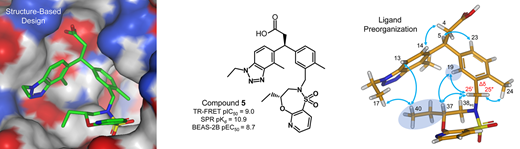
During the optimisation of PPI inhibitors, gaining high affinity for a PPI interfacial surface can be tricky (compared to a classic active site pocket) without making the compounds large and sprawling, in order to out-compete the protein partner. In this article, teams from GSK and Astex perform the lead optimisation of an inhibitor of the PPI between KEAP1 & NRF2, the latter of which is involved in a key natural antioxidant pathway which is down regulated by this PPI. The work began from a fragment screen of the Kelch-domain of KEAP1, which is a great way of screening potential targets for binding pockets and grooves, along with the chemical motifs/building-blocks that stick to them. While keeping key pharmacophoric elements (identified as hot-spots in the fragment screen) essential for affinity, subtle SAR is presented. Assays required development in order to measure the true affinity of the candidate from this work and the authors finally report a pKd of 10.9 and a dissociation half-life of ~4 hours via SPR. An investigation into ligand pre-organisation was conducted, with a range of data presented, including an overlay of the bound pose with the single-compound X-Ray crystal pose and analysis of solution state 1H NMR data. When you are at the astonishingly high levels of potency seen in this paper, pre-organisation becomes a relevant concern!
The candidate: GSK3227634 stands out from the crowd of current KEAP1 modifiers that activate NRF2, in that it is a non-covalent modifier, which brings with it the promise of decreased off-target pharmacology and thus a lower risk of side effects. It is a large molecule with high potency, low permeability and high systemic clearance. So why, you may ask, would you consider it for further clinical characterisation? It turns out that this profile cleanly fits the bill (or Target Candidate Profile?) for an inhaled lung-targeting treatment for COPD.
If you would like to read more, click here.
